My doctor said everything looked perfect. I still lost two pregnancies — before they even began.

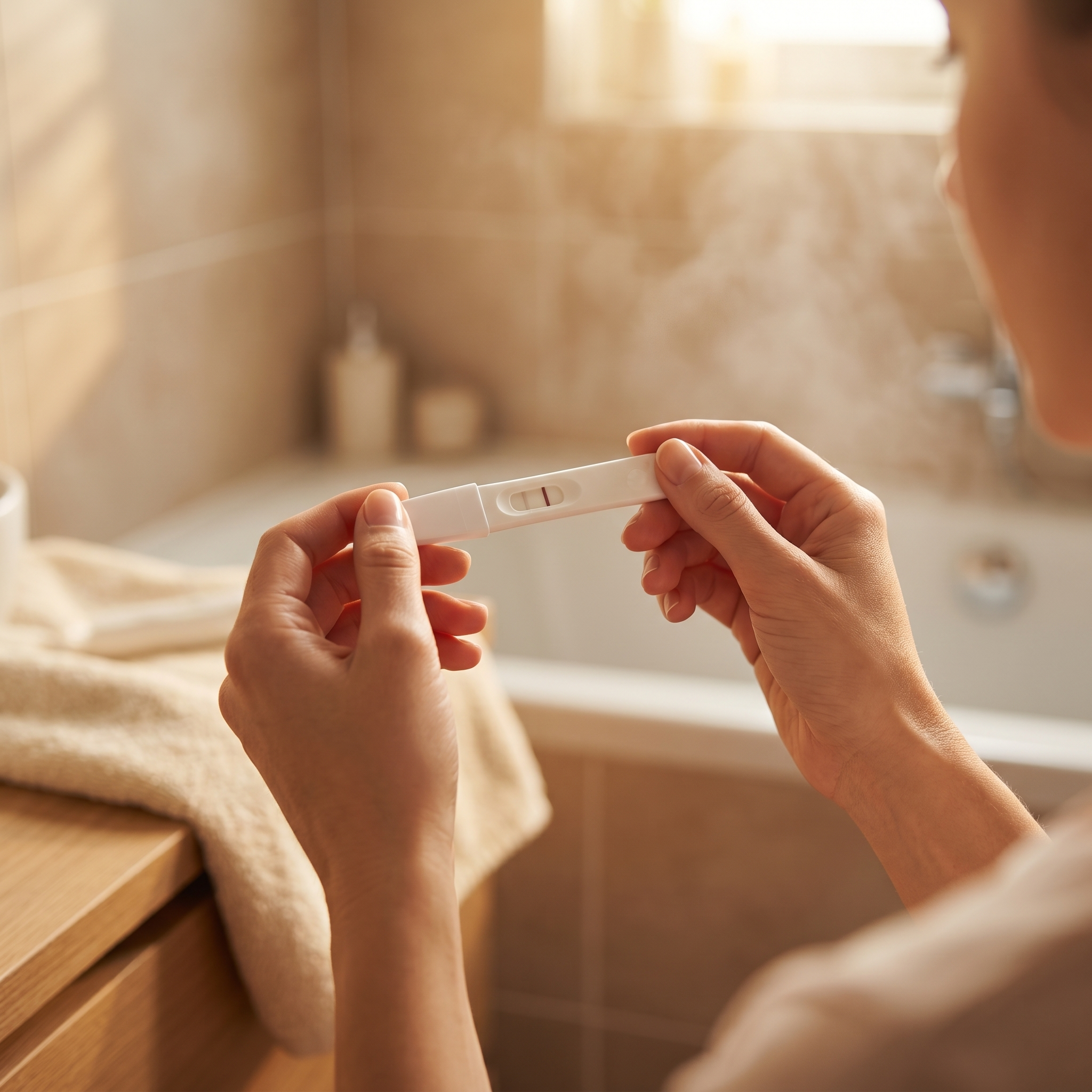
My OB leaned back and closed the folder.
"Progesterone is great. FSH is excellent. AMH is strong for your age. Ovulation confirmed on ultrasound."
Then she added, with the tone of someone wrapping up a meeting: "Lauren, there's really nothing wrong here. Sometimes it just takes a little more time. Try to relax."
I didn't want to relax. I wanted an answer. So I asked the one question I'd been saving.
"What about my lining? Can we check my lining thickness?"
She paused. Then shook her head slightly. "Your lining isn't the concern here. Your labs are completely normal. I wouldn't go down that road — it'll just give you something else to worry about."
I was 34 years old. Cycle number: 14.
And I had just lived through my second chemical pregnancy — the second positive test that dissolved within days.
But she wouldn't check the one place I was asking about.
If you're trying to conceive right now…
If you ovulate on time, your cycle comes like clockwork, your bloodwork is "normal" — and it still isn't happening…
If you've already seen that second line — faint, barely there — and watched it get lighter instead of darker, day after day, until it was gone…
If you've had to tell your partner "it's gone" before you ever got to tell anyone "I'm pregnant"…
If you asked your doctor about your lining and were told "it's fine" or "that's not the issue" or "let's not go there" — even though every instinct in your body said otherwise…
Then what I discovered in the four months after that night could be the difference between another pregnancy that disappears before it starts — and a test that finally stays positive.
Because I already know who you are.
You're the woman who doesn't accept "just keep trying." You never have been. You're the one who reads the studies at 2 AM. Who photographs every test strip at 10 DPO and holds it up to the light. Who knows her progesterone to the decimal point and her luteal phase length to the day.
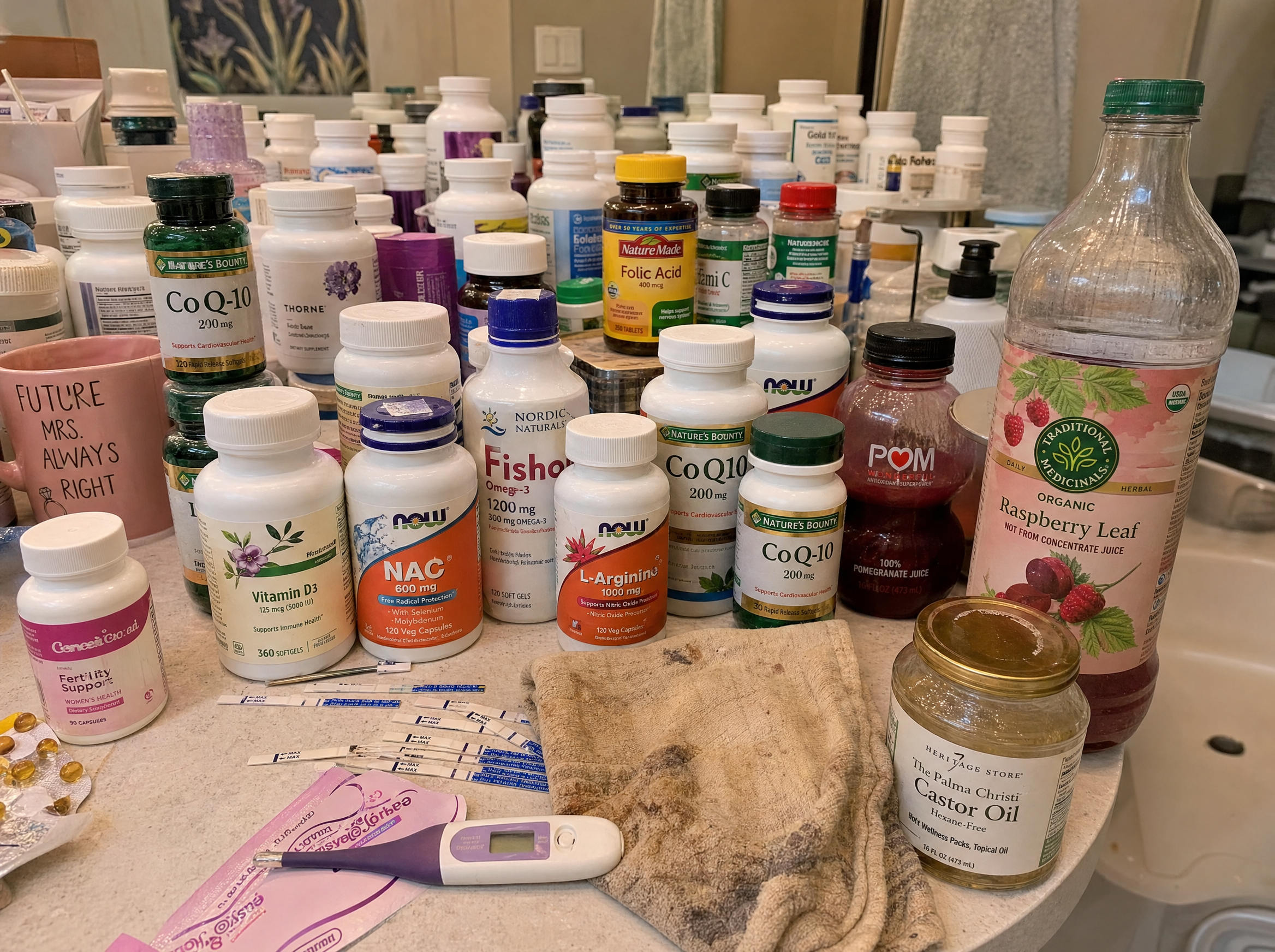
You're the one whose bathroom shelf looks like a supplement aisle — the L-arginine, the Vitamin E, the CoQ10, the beet juice you warm up in a mug, the pomegranate juice you can't stand the taste of anymore, the raspberry leaf tea, the NAC, the castor oil packs on your lower abdomen at night. All of it. Because sitting still while the clock runs isn't who you are.
I know. Because that was me.
My name is Lauren. I'm a project manager at a tech company in Denver. And five months ago I was sitting on the bathroom floor at eleven o'clock at night, hands shaking, holding a test strip — whose second line was getting lighter while I watched.
Not darker.
Lighter.
Again.
Everything was "normal" — except the outcome.
Let me go back.
Jake and I started trying in January 2024. My cycle was regular — 28 to 29 days. Basal body temp showed clear ovulation. OPKs were positive every month, right on schedule. "Everything looks great," my OB said at every visit.
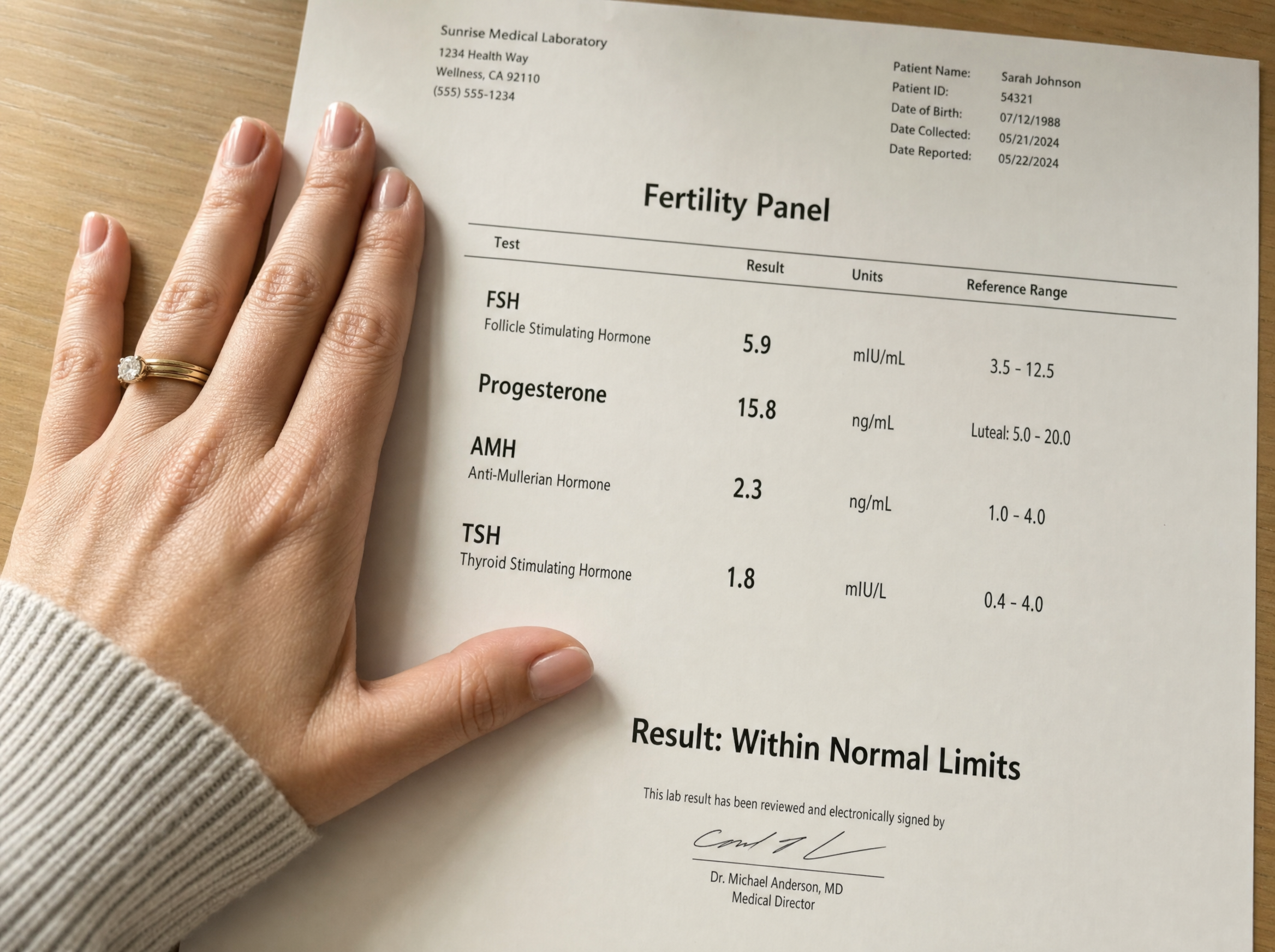
First real fertility workup. Bloodwork came back textbook. Progesterone 15.8. FSH 5.9. AMH 2.3. TSH 1.8. Ovulation confirmed on ultrasound. "Your numbers are honestly really good for 34," my OB told me. "Give it time."
Give it time. As if I had an unlimited supply of it.
Jake and I had stopped talking about "the topic." Sex by calendar. OPK sticks in the bathroom drawer. The app pinging me at 7 AM: fertile window opens today! — as if that was information I needed from my phone. I'd started muting the group chat when friends posted ultrasound photos. I'd stopped going to baby showers.
By now my supplement shelf was absurd. Prenatal, CoQ10, fish oil, Vitamin D, Vitamin E, myo-inositol, magnesium. I was choking down eight capsules every morning and telling myself this month will be different.
Cycle 11:
The test showed two lines.
I was standing in the bathroom at 6 AM. My hands were shaking. I photographed the test. Twice. Three times. I adjusted the angle. Held it under the light. Squinted. It was there. It was faint, but it was there.
I walked into the bedroom and showed Jake. He pulled me in and held me. We stood there, not saying anything, for a full minute. I could feel his heartbeat through his shirt.
I called my OB's office the next morning.
Beta HCG from the blood draw: 31.
Three days later: 19.
Five days later: under 5.
"Chemical pregnancy," the nurse said over the phone. "It happens more often than you'd think. The embryo didn't implant properly." She told me I could try again next cycle.
Didn't implant properly.
That phrase lodged in me like a splinter. But I didn't understand it. Not yet.
Cycle 14:
It happened again.
Two lines. Faint, but there. This time I didn't tell Jake right away. I couldn't. I waited for the blood draw.
Beta HCG: 44.
Two days later: 27.
Four days later: under 5.
The same sequence. The same numbers falling. The same nothing at the end.
At the follow-up, I asked my OB again. Directly. "Can we please check my lining? Can we at least measure it?"
She sighed. Actually sighed. Then she said: "Lauren, your lining is not the problem. It might be on the thinner side, but it's perfectly adequate. We've been through your labs. Everything is normal. If it happens a third time, I'll refer you to an RE."
A third time.
She needed me to lose a third pregnancy before she would look at the one place I was begging her to check.
I sat in my car in the parking lot for twenty minutes. I didn't cry. I was past crying. I just sat there with my hands on the steering wheel and thought: My body gets to the door. It opens the door. And then everything collapses. And nobody will tell me why.
That night Jake was asleep. I wasn't.
I lay in bed with my phone on my chest, staring at the ceiling. And then I did something I'd never done before. I logged into my patient portal and pulled up my imaging records.
There was an ultrasound from seven months earlier — a baseline scan my OB had ordered for an unrelated reason. In the notes, buried between the ovarian measurements and the uterine dimensions, I found a single line:
Endometrial thickness: 5.4 mm.
My OB had never mentioned this number. Not once. I didn't even know it existed until I went looking for it myself.
I opened Google. I typed: "endometrial thickness for implantation."
Every source said the same thing. Below 7 mm, implantation rates drop significantly. Below 8 mm, many clinics won't even proceed with a transfer. Studies with thousands of cycles showed the pregnancy rate at 7 mm or below was less than half compared to thicker linings.
Mine was 5.4.
My OB had called it "perfectly adequate."
I closed the portal. I opened Reddit.

Then, at 3 AM, I found the answer three OB-GYNs had never looked for.
The discovery that changed everything
After the second chemical I couldn't sleep. Every night was the same — I'd toss for an hour, then pick up my phone and scroll. Reddit. r/TryingForABaby. r/infertility. Thread after thread. Stories identical to mine. Women who ovulated perfectly, had great labs, timed everything right — and still nothing. Or worse: positives that faded.
Then one night, a post on r/TryingForABaby stopped me cold:
"Repeat chemicals — has anyone had their lining thickness actually measured?"
I clicked.
The original poster described my exact situation. Regular ovulation. Perfect bloodwork. Two chemicals. Her OB said "everything is fine, it's all on my husband's side." So she pulled up her own ultrasound records — and found her lining was 4.4 mm at 6 DPO. She'd Googled it and discovered that 4.4 was not fine. That many sources said it wasn't thick enough to support pregnancy. That her OB had missed it. Or ignored it.
The replies were a flood:
"My lining was thin this week pre-trigger so my RE prescribed estrogen. Might be worth a shot to ask?"
"Same thing happened to me! Thin lining pre-trigger, got put on estrogen, and it thickened enough because I got pregnant that cycle!"
"I'm looking for a new doctor. I asked the old one this week if we could review it again and she said it's not an issue and although it's 'on the thin side' it's perfectly fine."
Reading that last one felt like reading my own story typed by a stranger.
Then, deeper in the thread, one comment made me sit straight up in bed:
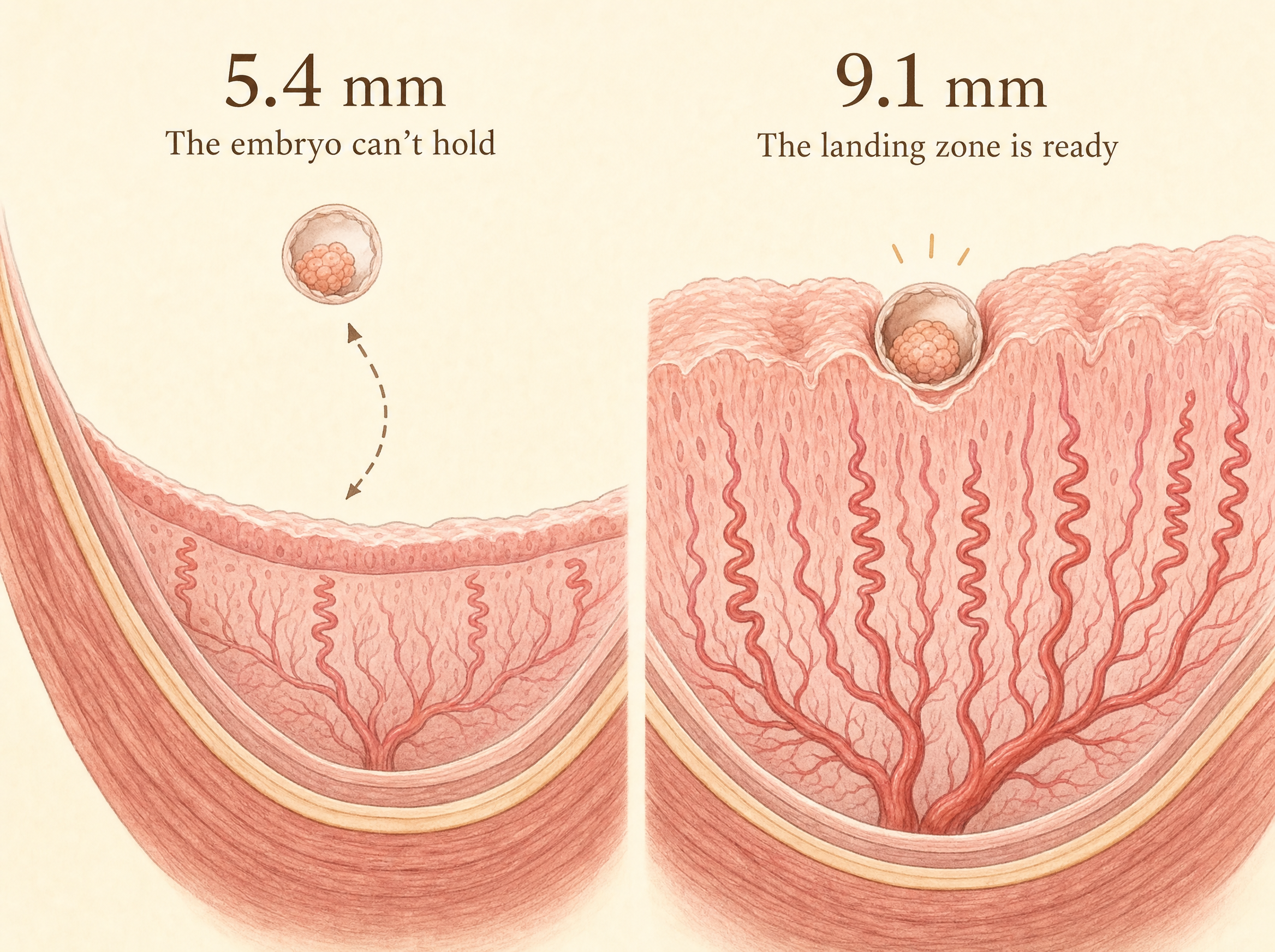
The landing zone.
I'd been so focused on the egg. The ovulation. The timing. The sperm. But nobody — not my OB, not my apps, not a single supplement on my shelf — had ever addressed the place the embryo actually has to land.
And mine, according to a number buried in my own chart that no one had ever mentioned, was barely half the thickness it needed to be.
The implantation window — the second gate nobody checks
In that thread and the studies it linked to, I understood for the first time what was actually happening inside my body.
Every fertility guide, every OB, every app, every supplement — they all focus on the first gate: ovulation, fertilization, egg quality. That's where the whole conversation lives. CoQ10 for your eggs. Inositol for your cycle. Prenatals for the baby. Always that first gate.
But there's a second gate, just as decisive — and almost never examined:
The implantation window.
Here's what I learned:
Step 1: The embryo needs a place to land.
After fertilization, the embryo travels for 5 to 7 days through the fallopian tube into the uterus. There it has to implant into the endometrium — the lining of the uterus. This lining isn't a passive container. It's a living, active tissue that has to be thick enough, well-supplied with blood, and protected from oxidative damage to receive the embryo, anchor it, and nourish it.
Step 2: Below 7–8 mm, the embryo can't hold.
A meta-analysis of over ten thousand cycles found that the pregnancy rate with a lining at or below 7 mm was less than half compared to thicker linings. The difference between 5 mm and 9 mm isn't marginal. It's the difference between an embryo that anchors and one that slips away. A chemical pregnancy. A positive test that disappears.
Step 3: The lining needs blood flow.
The endometrium is fed by a network of tiny coiled vessels called spiral arteries. If those vessels are constricted, the lining doesn't get enough oxygen, enough nutrients, enough building material. It stays thin. And nobody catches it — because standard bloodwork measures hormones, progesterone, AMH, thyroid. It measures everything except the place where the embryo actually has to land.
Step 4: Your ovulation app goes silent at the exact moment this window opens.
Here's the part that made me furious. Every app I owned — the Flo, the Premom, the Mira — celebrated ovulation and then went completely dark. No guidance. No tracking. Nothing. For two weeks. Meanwhile, inside my body, the single most critical window of my entire cycle was happening: the lining was supposed to be building, the spiral arteries were supposed to be opening, the landing zone was supposed to be getting ready. And every single tool I had went quiet at the exact moment it mattered most.
The embryo forms. It travels. It arrives. And it finds a landing zone that isn't ready to hold it.
I was sitting in bed at 2:47 in the morning.
And for the first time since two lost pregnancies, everything made sense.
My body wasn't broken. My eggs weren't the problem. My ovulation worked fine.
The problem was never the traveler. It was the landing zone.
Why everything on my shelf was working on the wrong gate
I looked at my bathroom counter the next morning and it hit me. I counted: eleven bottles. A prenatal. CoQ10. Fish oil. Vitamin D. Vitamin E. Myo-inositol. Magnesium. NAC. L-arginine capsules. A bottle of beet juice concentrate. A box of raspberry leaf tea bags.
Plus the castor oil packs I was laying across my abdomen at night. Plus the pomegranate juice I'd been choking down for three months and couldn't stand the taste of anymore.
Thirteen things. And suddenly I could see why none of them had worked — even though some of them were aimed at the right mechanism.
My prenatal (the Ritual, the one everyone takes):
Supports cell division and fetal development. Essential — no argument. But prenatals have zero effect on uterine blood flow. They prepare the passenger for the journey — they don't build the runway it has to land on.
CoQ10 (the egg-quality supplement my OB recommended):
Supports mitochondrial energy in the egg. Great — but my eggs weren't the problem. I was getting pregnant. The embryo was forming. CoQ10 works on the first gate. It doesn't build the lining. It doesn't open the spiral arteries. It doesn't prepare the landing zone.
Progesterone (prescribed after the first chemical):
Supports the luteal phase hormonally — but when the physical infrastructure is missing, when the lining is too thin and too poorly supplied with blood, progesterone alone can't build a landing zone where there isn't one.
The L-arginine capsules, the Vitamin E, the beet juice, the pomegranate, the castor oil packs, the raspberry leaf tea:
Here's the painful part. Some of these were actually aimed at the right mechanism — blood flow, antioxidant protection, lining support. I'd found them on Reddit threads exactly like the one I was reading now. But I was taking random doses from random bottles at random times with no coherent protocol. The L-arginine capsules sat in my gut half the time. The beet juice tasted worse every week. The castor oil made a mess. I was DIY-ing the right idea with the wrong delivery — twelve separate bottles doing twelve separate things, none of them designed to work together on the specific window that mattered.
Every solution on my shelf worked at the first gate — eggs, ovulation, hormones — or was a scattered attempt at the second gate with no real strategy.
But my problem was at the second gate: the place where the embryo had to land.
And that place needs three things at the same time:
I didn't need another supplement for my ovulation. I didn't need a thirteenth bottle on my shelf.
I needed one thing that gave my embryo a place to stay.
And then I found it.
"After 8 weeks my lining was at 9.1 mm"
Deeper in that same Reddit thread, a woman described something that sounded almost too familiar. She'd been on her own "rampage" — her word — after her doctor refused to help. She'd bought L-arginine and Vitamin E separately, doubled the doses, added beet juice and pomegranate, used a heating pack on her abdomen, massaged her lower belly before bed, ate estrogen-rich foods for 48 straight hours.
Her lining went from 6.9 to 10.9 in two days.
I read that and felt two things at once: hope that the mechanism was real, and exhaustion at the thought of managing another DIY protocol with six bottles and a heating pad.
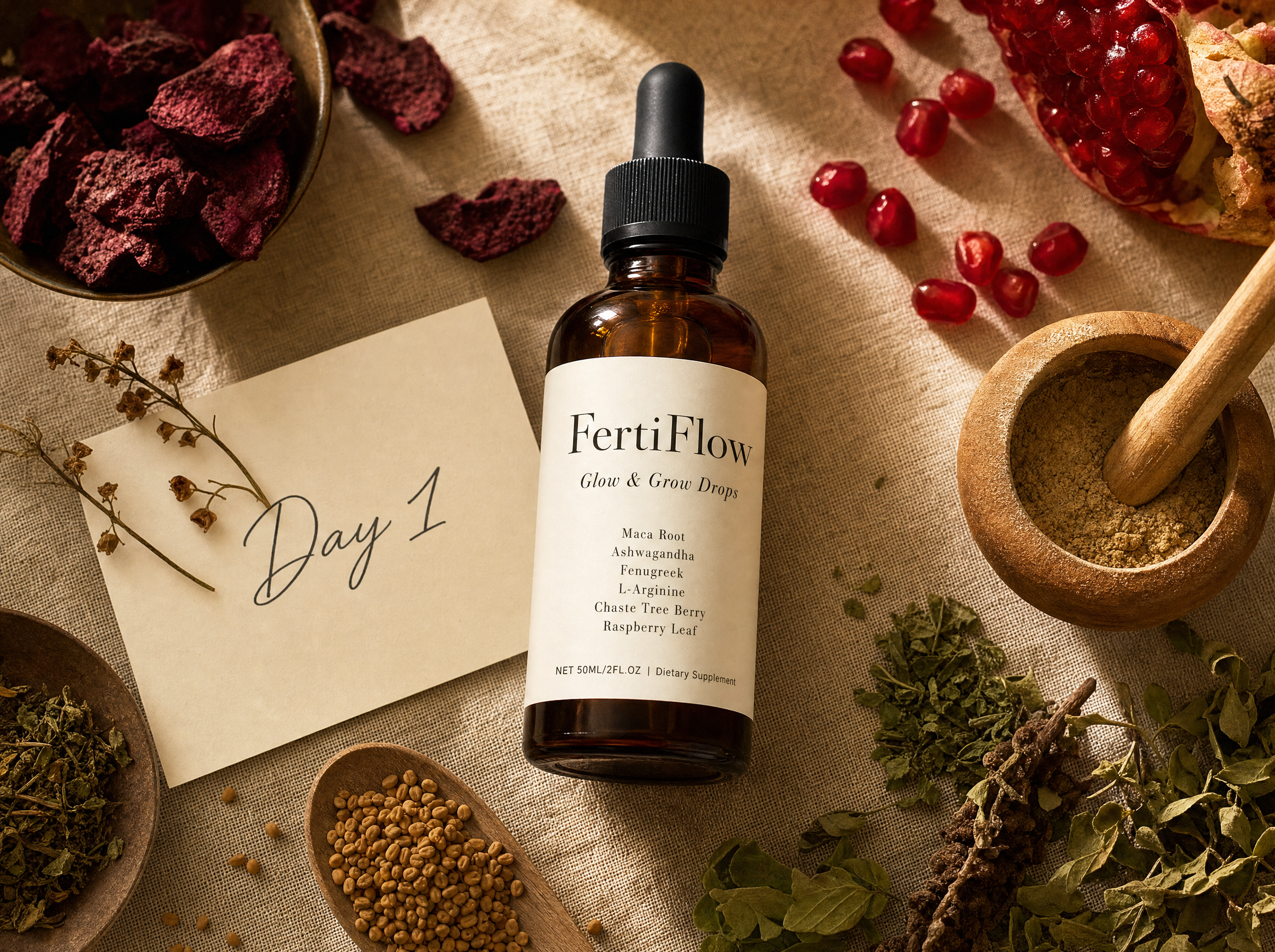
Then, two replies down, someone mentioned a product that combined the core ingredients into a single formula: Glow & Grow — Fertility Drops.
I was skeptical. After two chemicals, I was skeptical of everything. Of supplements, of advice, of hope itself. But I'd also learned something in those 3 AM Reddit sessions that I couldn't unlearn: the ingredients women were using — L-arginine, Vitamin E, dietary nitrate from beets and pomegranate — those weren't random folk remedies. They mapped to real mechanisms. Real studies. Real pathways.
The problem was never the ingredients. It was the way I'd been taking them — loose, uncoordinated, random doses, wrong timing, half of it sitting in my gut.
So I looked at the formula:
L-Arginine:
The amino acid your body converts into nitric oxide — a natural vasodilator that relaxes blood vessel walls and supports uterine artery flow. Studies on women with thin linings found L-arginine improved radial-artery blood flow and supported endometrial thickness. The precursor the spiral arteries need to open. I'd been taking this as a capsule for months — but in a formula designed to work with the other ingredients, at the right dose, in a format my body could actually absorb during the window that matters.
Vitamin E:
A fat-soluble antioxidant that protects endometrial tissue from oxidative damage. In the same clinical pilot, Vitamin E improved radial-artery blood flow in over 70% of thin-lining patients and supported endometrial growth. The shield the landing zone needs. I'd been taking a separate Vitamin E capsule — now it was part of a coherent formula instead of another orphan bottle.
Beetroot + Pomegranate extract:
Dietary nitrate sources. Your body converts nitrate into nitric oxide through a second pathway — backing up the L-arginine route from a different angle. Pomegranate adds polyphenol antioxidants. Two roads to the same destination. This was the mechanism behind the beet juice I'd been choking down for months — except now it was measured, concentrated, and I didn't have to taste it.
It was liquid. Not another capsule to add to the pile. Not another juice that tasted worse every week. A single measured daily drop — timed to the days after ovulation, when the landing zone actually matters.
I didn't need a guarantee that it would work. I needed something real to do during the two weeks I'd been doing nothing. Something designed for the exact window my apps, my doctor, and every supplement on my shelf had been ignoring.
I ordered the 3-month supply.
The recommendation was at least 2 to 3 cycles — because the lining rebuilds from scratch every single cycle. Consistent support, not a weekend fix. That actually reassured me. Anyone promising "pregnant in 7 days" doesn't understand the biology. I'd seen enough fake promises to know the difference.
The transformation — in numbers
The first change wasn't in my cycle. It was in my sleep. For the first time in months I slept through the night without waking at 3 AM to count cycle days and Google "5 DPO symptoms." The constant low-grade dread — that hum that had lived in my chest since the first chemical — had softened into something I almost didn't recognize.
My cervical mucus changed too — clearer, stretchier, lasting several days instead of one. Small signals. But after fourteen months of nothing changing, any signal felt like proof that something was different inside.
I'd switched OBs by now. The new one actually listened. I asked for a mid-luteal ultrasound to measure endometrial thickness. She agreed without hesitation. Cycle day 21 —
"9.1 millimeters. Trilaminar pattern. That's a really nice lining."
I stared at her. "What was it before?"
She scrolled through my chart. Found the old ultrasound from the year before — the one nobody had flagged.
5.4 mm.
"That's a significant difference," she said. "What have you been doing differently?"
I told her about the drops. About the blood flow pathway. About the spiral arteries. About the implantation window. About the months I'd spent asking my previous OB to check this number and being told "that's not the issue."
She nodded slowly. "The logic tracks. Keep going."
I sat in my car after that appointment, and for the first time in over a year, I cried from something other than loss.
Cycle 19 (Month 3 with Glow & Grow):
Day 28. No cramping. No spotting. No sign that my period was coming.
Day 30. I was standing in the bathroom. The same bathroom. The same spot where five months earlier I'd watched a line fade until it was gone.
I took the test.
Two lines. Strong. Clear. Immediately visible. No fading. No waiting. No squinting under the light.
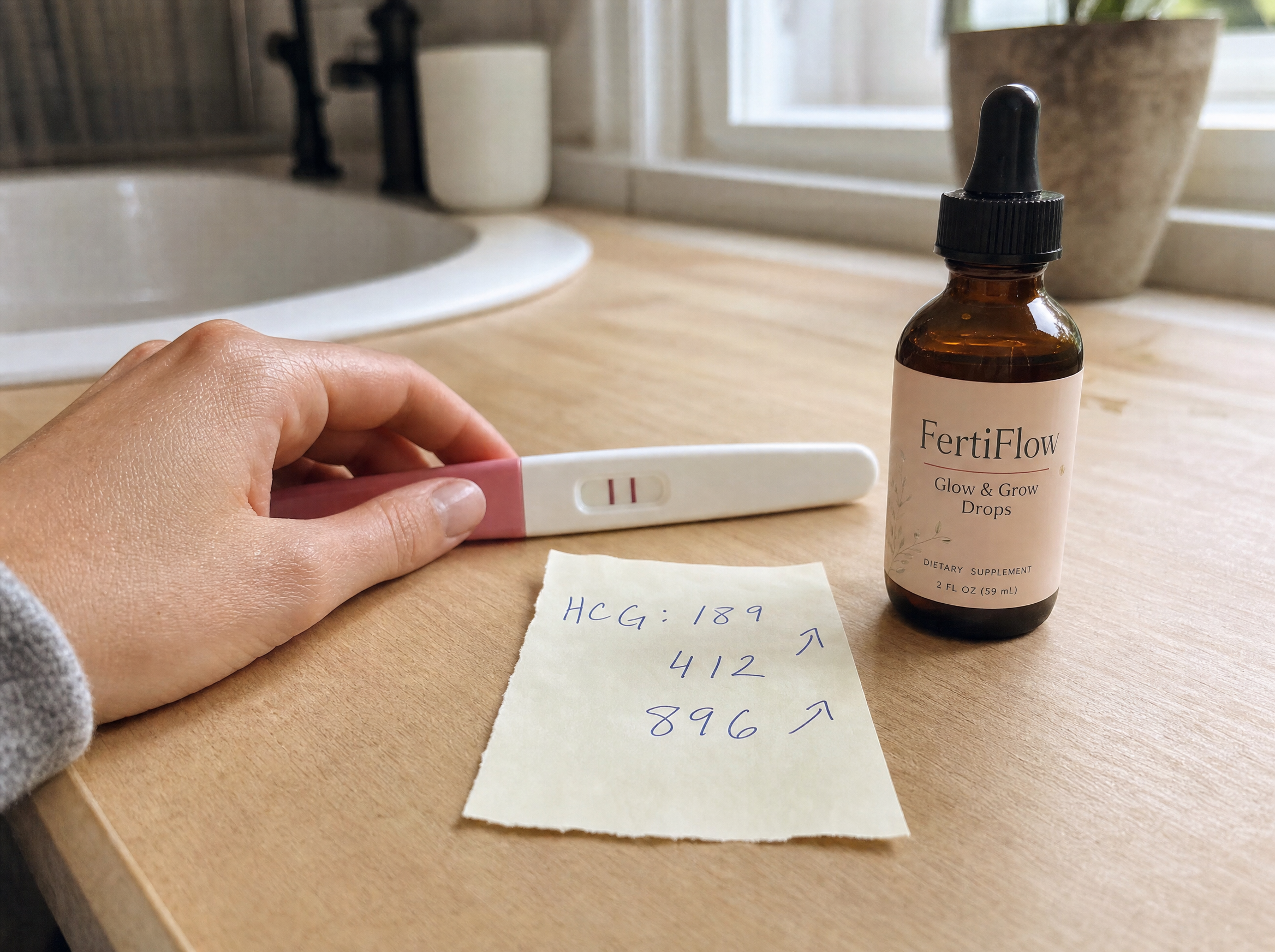
Beta HCG: 189.
Three days later: 412.
Five days later: 896.
Doubling. Clean doubling.
No dropping. No disappearing. No phone call from a nurse saying "unfortunately."
My embryo had landed — and this time, the landing zone held.
Why it worked — and why Glow & Grow is different

Let me be clear about something: Glow & Grow is not a miracle product.
It doesn't guarantee pregnancy. It can't open blocked tubes or fix structural problems that need surgery. I brought my bottle to my new OB. She looked at the label, looked at the ingredients, and said: "This makes sense alongside what we're doing. Keep taking it."
That's what I needed to hear. Not a miracle claim. Permission to act — from a doctor who actually looked.
It's the first thing I found that doesn't work on the first gate — it works on the second:
And because it's a liquid, it replaced six of the bottles on my shelf with a single daily ritual. No more choking down capsules that sat in my gut. No more warming up beet juice in a mug. No more castor oil mess. One measured dose, timed to the days after ovulation — the days my apps stopped tracking and my old OB refused to check.
The days when the second gate opens.
The days when the landing zone has to be ready.
"But isn't this just another expensive supplement?"

I understand the skepticism. I'd lost two positive tests. I didn't believe in anything anymore. I'd tried the individual ingredients — the L-arginine capsules, the Vitamin E, the beet juice — and nothing had changed. Why would a formula with the same things be any different?
Here's what I've come to believe: the ingredients were never the problem. The problem was twelve bottles doing twelve separate things, at random doses, at random times, with no protocol designed around the window that matters. The same way you can have all the right building materials in a pile on a lot and still not have a house — until someone organizes them into a blueprint.
Glow & Grow was developed by women who lived this — women who spent years trying and hit the same wall I did: every product on the shelf worked on eggs, ovulation, or hormones. Nobody was building for the place where the embryo actually has to land.
Made in Germany · Lab-tested for purity and potency
L-Arginine + Vitamin E lead formula — the two ingredients with the most clinical support for uterine lining and blood flow
Liquid format — one daily ritual, not another pill to choke down
Designed to complement your doctor's care, not replace it
And the most important part: 90-day money-back guarantee.
If it doesn't work for you, you get your money back. No questions.
That's not a risk. That's three months for your lining that it wouldn't otherwise get.
What would have happened if I hadn't found that thread
I think about this sometimes.
If I hadn't opened Reddit at 3 AM that night. If I hadn't clicked on that post about lining thickness. If I hadn't scrolled deep enough to find the comment that changed everything.
I'd be on cycle 22 right now. Maybe 23. Still taking the same prenatal. Still choking down CoQ10 for eggs that were never the problem. Still warming up beet juice I hated. Still adding another bottle to a shelf that already looked like a pharmacy. Still watching my ovulation app celebrate a positive OPK and then go dark for two weeks while I sat in the silence of the two-week wait, Googling "6 DPO symptoms" at midnight, knowing in my gut that nothing had changed.
Still sitting across from a doctor who would tell me my labs look great.
Still pulling up test strips that showed a line getting lighter instead of darker.
Still telling Jake "it's gone" before I ever got to tell anyone "I'm pregnant."
And still — after all of it — never once having the one thing checked that actually mattered.

You're not the kind of woman who waits. You've never been. You figured out your ovulation on your own. You caught your own thin lining before your doctor did. You've tried the beet juice, the L-arginine capsules, the heating packs, the castor oil, the raspberry leaf tea. You did all of it because sitting still while the clock runs isn't who you are.
You're the woman who goes on a rampage at 2 AM because her doctor won't act. Who pieces together answers from Reddit threads and PubMed abstracts. Who takes matters into her own hands when nobody else will.
You are already doing the work. Now it's time to do the right work — on the right gate.
I was on cycle 14 when I finally understood that my problem was never ovulation.
It was the landing zone.
I wish I'd known at cycle 7 — before the first chemical. Before the first test that disappeared. Before the night I had to look at Jake and say: "It's gone again."
You don't have to make the same mistake.
Your lining rebuilds from scratch every single cycle. That means a new window is opening in a matter of weeks. And this time, you can support it.
Every cycle where the landing zone goes unsupported is another window opening and closing without the second gate being ready.
Every month you wait is a month you're working on the first gate while the second gate goes ignored.

3-Month Supply: Your lining rebuilds every cycle. Give it 2–3 cycles of real support.
Check Availability >>Why 3 months? Building endometrial thickness and improving uterine circulation aren't overnight effects. The spiral arteries need time to respond. The lining needs cycles to build. 2–3 months is the biological minimum — and the reason this product doesn't make a 7-day promise.